Pricing guide
What a Cape Hatteras ORV permit costs
The National Park Service's published ORV permit fees for Cape Hatteras, the vehicle and equipment requirements behind them, the seasonal closures attached to the fee, and how a family should weigh the permit against putting everyone on bikes.
The fee, exactly as the Park Service publishes it
Cape Hatteras National Seashore charges ORV permit $50 / 10 days, $120 annual. There are two types of ORV permits and no third tier: a ten-consecutive-day permit and an annual permit that runs one year from the date you buy it, not to a calendar year end. Each vehicle needs its own permit, displayed in the lower corner of the windshield, and the permit follows the vehicle rather than the driver.
The break-even is arithmetic anyone can do at the kitchen table. If you will be on this coast more than twice in twelve months, the annual permit is the cheaper instrument. If this is a single week in a single summer, the ten-day permit is. There is no family rate, no second-vehicle discount, and a household that brings two trucks buys two permits.
What the fee is not, which surprises most visitors
The permit is not admission. Cape Hatteras charges no entrance fee at Cape Hatteras National Seashore: no gate, no per-car fee, no wristband, no pass to buy before you can walk onto sixty-odd miles of beach. Fees at this park attach to exactly three things — camping, lighthouse climbs, and off-road vehicle permits — and everything else about being in the park is free.
That distinction is worth being clear about before a family spends money it does not need to spend. You do not need an ORV permit to get to the beach. You need one to drive a vehicle onto the sand. Every foot of the seashore reachable by a parking area, a boardwalk, a bike or a pair of legs is reachable without buying anything at all.
The vehicle behind the fee has to qualify
The permit price is the last hurdle rather than the first. To hold a Cape Hatteras ORV permit at all, ORVs must be registered, licensed, insured for highway use — and the excluded list catches a lot of people. Side-by-sides, all-terrain vehicles, golf carts and motorcycles are prohibited on the beach even where they are licensed for road use, and no permit fee makes any of them eligible.
The vehicle also has to be under two axles and running tyres listed or approved by the U.S. Department of Transportation. Read plainly, the permit assumes an ordinary registered, insured, street-legal truck or SUV with the air let out of its tyres, and it assumes the driver knows how to do that. It is not a toy pass.
The equipment the fee assumes you are carrying
Buying the permit does not buy help. Required equipment inside a permitted vehicle on this seashore includes a shovel, jack, jack support board, low-pressure gauge, and the reason is stated flatly by the Park Service: staff are not allowed to pull or tow a stuck vehicle. Get buried on the sand and you are digging, or you are paying a private recovery operator, and there is no third option.
For a family visiting once, that is a genuine cost the fee does not include: the tools if you do not own them, the tyre pressure knowledge if you have not done it before, and the risk of an afternoon spent under a truck rather than on the beach. Experienced beach drivers handle this without thinking. First-timers regularly do not, and the fee does not care which you are.
There is a calendar attached to the permit
A permit is permission to drive where and when driving is open, which is not everywhere and not always. ORV seasonal closures April 15 – October 14 across parts of the seashore, routes can close earlier for resource protection or capacity, and night driving generally resumes on November 16 and runs through April 30, with September 15 the earliest possible transition on some routes.
So the annual permit and the ten-day permit do not buy proportional amounts of beach. A ten-day permit in late July buys access to the shortest version of the route network in the year; the same money in November buys considerably more, including the ability to be out there after dark. Families who buy on price alone and discover the closure map afterwards are the ones who feel the fee was wasted.
The arithmetic a family is actually doing
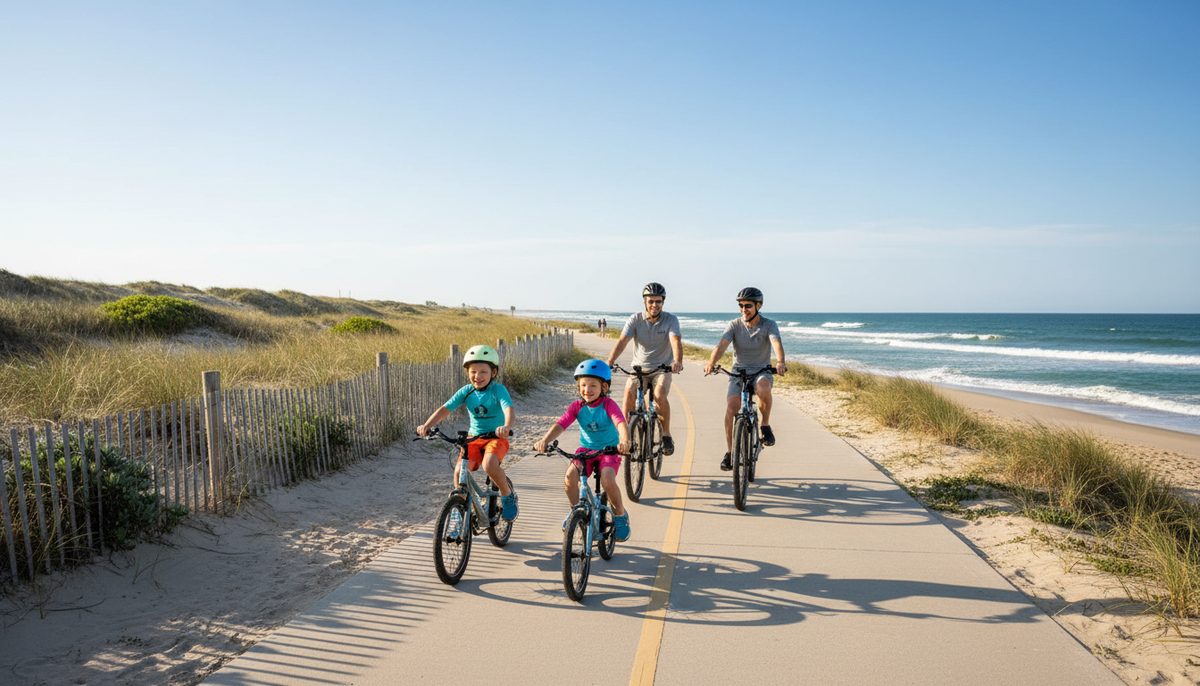
Most families weighing this are not really asking about permits. They are asking how to spend a week on a narrow island without everybody sitting in a truck. Put the permit against the alternative honestly: the permit puts one vehicle on one stretch of sand at a time, has to be bought per vehicle, requires equipment and a skill, and closes seasonally. A machine that meets G.S. 20-4.01(7a) — Electric Assisted Bicycle — 750 watts or less, 20 miles per hour or less under motor alone, pedals that work — requires no permit, no registration, no insurance, no recovery kit, and parks anywhere.
That is not an argument that nobody should buy an ORV permit. Surf fishermen with a truckload of rods and coolers have a reason the permit exists to serve, and the annual permit is excellent value for anyone who is here often. It is an argument that a family whose actual goal is to move around the island for a week should price the permit against what a set of bikes does before they assume the truck is the answer.
If the trip is really about getting everyone moving rather than getting a truck on the sand, tell us the ages and the number of riders and we will size a family set for the week — no permit, no recovery kit, and nothing to display in a windscreen.
On the record: ORV permit $50 / 10 days, $120 annual (National Park Service — Cape Hatteras National Seashore, Fees & Passes (nps.gov, retrieved 2026-09-17)) · two types of ORV permits (Recreation.gov — Cape Hatteras National Seashore ORV Permit (retrieved 2026-09-17)) · G.S. 20-4.01(7a) — Electric Assisted Bicycle (N.C. General Statutes § 20-4.01 — Definitions, subdivision (7a) (ncleg.gov, retrieved 2026-09-17))
Hand-verified 2026-09-17 against the primary sources named above; where a fact could not be verified it was left out, never guessed.