Pricing guide
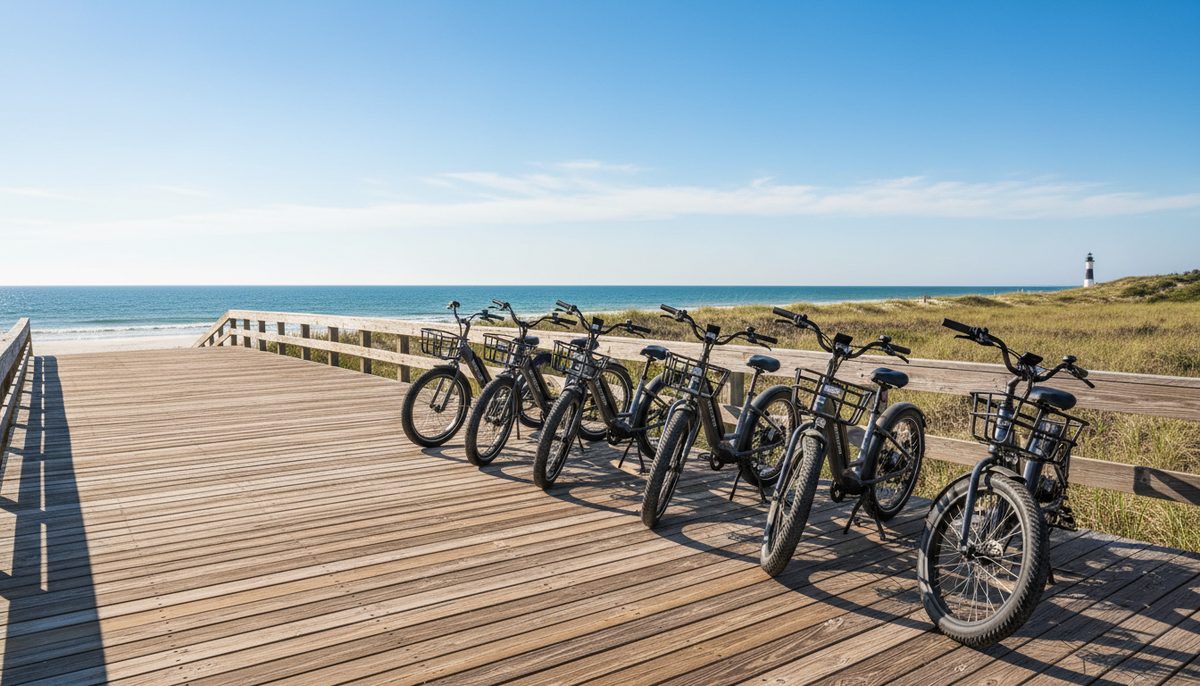
What an Outer Banks e-bike rental costs
What an Outer Banks e-bike rental costs, honestly: why no one can publish a fleet-wide rate, the public numbers that land on the same vacation day, and the one equipment choice that turns a cheap bike into a registered motor vehicle.
The rate we are not going to invent
Search this question and you will get a tidy dollar range within the first three results, usually with no source attached to it. We are not going to add another one. There is no dated, authoritative, Outer Banks-wide rate table for electric bicycle rentals — every outfitter on this strand publishes its own sheet, those sheets move with the week of the season, and averaging them into a number would be marketing dressed up as research. Our facts file leaves the figure out on purpose, and this page inherits that decision.
What we can do instead is more useful than a fake average. Almost every other dollar that lands on an Outer Banks riding day is published by a government agency, fixed in statute or posted on a fee page, and none of it is negotiable. Set those out, explain the handful of things that genuinely move an outfitter's own number, and you can read any quote you are given — ours or anyone else's — and know whether it is complete.
The compliance cost of a legal e-bike is zero dollars
Start with the machine, because the machine decides whether you owe the state anything at all. North Carolina writes the boundary at G.S. 20-4.01(7a) — Electric Assisted Bicycle: two or three wheels, a seat or saddle, fully operable pedals, an electric motor no larger than 750 watts, and a maximum speed on a level surface under motor power alone of no more than 20 miles per hour. Everything inside that envelope is a bicycle for registration purposes.
That matters financially because the state charges nothing for it. A bike inside the definition has no title, no licence plate, no annual registration, no inspection and no mandatory liability policy. The statute also closes the obvious loophole in the other direction — e-bike is not a 'motor-driven bicycle' — so a compliant e-bike cannot be reclassified into the moped column by an enthusiastic reading. The cost of being legal on a 20-mph e-bike in this state is zero dollars, and that is the single largest reason renting one is cheaper than renting anything with a motor vehicle behind it.
The cheapest-looking bike is sometimes the one that costs the most
Now the trap. Bikes marketed as 28-mph pedal-assist machines are sold at ordinary bicycle prices and look identical on a rack. Under the law in force today, a 28-mph e-bike is a moped under current NC law — the operator has to be at least sixteen, the machine has to be registered with the Division of Motor Vehicles, it has to carry liability insurance, and both operator and passenger have to wear a helmet built to the federal motorcycle standard rather than a bicycle helmet.
Registration fees, an insurance binder and two DOT-certified helmets are not small money against a week's rental, and none of it is on the sticker. It is also the reason a responsible rental fleet on this coast is built out of 20-mph machines: everything in it can be handed to a customer with nothing but a helmet and a set of instructions. If a quote you are comparing includes a faster bike, the honest comparison has to include the paperwork that comes with it.
Who is allowed on the bike changes what you have to rent
Two age numbers do more to shape a family's bill than any rate sheet. The first is operational: NCDOT's Integrated Mobility Division states a minimum operating age 16 for electric assisted bicycles, so a thirteen-year-old is not going to be handed a bike of their own regardless of how tall they are. The second is protective: Helmet required under age 16 (G.S. 20-171.9) applies to anyone below sixteen, riding or carried as a passenger, on a public roadway, a public bicycle path or any other public right-of-way.
Read together, those two rules mean a family with young children is not renting one bike per body. It is renting adult bikes plus the carrying equipment that puts the children legally and safely on them, and that changes the shape of the quote before a single rate is discussed. The enforcement side is mild — helmet violation fine capped at $10, charged to the parent rather than the child, and the first offence can be waived on proof that a helmet was bought — but the statute is not really aimed at the fine. Tell an outfitter the ages in the party first. It is the question that determines the equipment, and the equipment determines the number.
The published numbers that land on the same vacation day
Around the rental itself sits a set of fees anyone can look up. The national seashore that occupies most of the riding distance on this coast charges no entrance fee at Cape Hatteras National Seashore — there is no gate, no per-car admission and no wristband; fees attach only to camping, lighthouse climbs and off-road vehicle permits. Crossing to Ocracoke on the passenger ferry is round-trip $15, bicycle $1, which is the cheapest line item of any consequence in an Outer Banks week. Climbing the Bodie Island Lighthouse runs Bodie Island Lighthouse climb $10 adult, with children under twelve and seniors sixty-two and over at five, and it is worth knowing before you plan around it that Cape Hatteras Lighthouse closed for climbing in 2026.
If anyone in the party is weighing driving on the sand instead, that is a separate and considerably larger ladder: ORV permit $50 / 10 days, $120 annual, per vehicle, on a truck that already has to be registered, licensed and insured for highway use. Those four published numbers, plus a rental rate, are the entire cost of a riding-centred week here. None of them is hidden and none of them is ours.
What genuinely moves an outfitter's own number
Four things, and only one of them is about the bicycle. The first is the week. Demand on this strand is concentrated into a narrow midsummer band, and a fleet with every machine out the door on a July Saturday has nothing to discuss; the same fleet in late September has a great deal to discuss. The second is duration, and it is not linear — the labour of a rental is concentrated in the handover and the return, so a week almost never costs seven times a day.
The third is delivery. A bike brought to a rental house, fitted at the door and collected at the end of the stay costs more than a bike collected from a shop, and it costs more the further north or south of the shop the house sits. That is a real logistics cost, not a surcharge, and any outfitter should be able to tell you what it is before you book. The fourth is what comes with the bike: helmets, a lock, a rear rack or basket, a phone mount, a spare battery for a long day. Ask whether each is included or added, because two quotes with a forty-dollar spread often differ by exactly one of them.
Four questions that make two quotes comparable
What is the motor-only top speed of the bike you are quoting, so I know whether I am renting a bicycle or a moped? Are helmets included, and do you carry the sizes my children actually need? Is delivery to my address in the number, or added to it? And what happens if a battery dies at the far end of the island on day three — do you come out, and is that a call-out fee?
An outfitter who answers all four without pausing has told you what they are like to deal with on the day something goes wrong, which is worth more than the spread between quotes. An outfitter who answers none of them has told you that too.
Tell us your dates, the ages riding, and the address you are staying at — you will get a firm number for that week, with the delivery question and the helmet question answered before you have to ask them.
On the record: G.S. 20-4.01(7a) — Electric Assisted Bicycle (N.C. General Statutes § 20-4.01 — Definitions, subdivision (7a) (ncleg.gov, retrieved 2026-09-17)) · minimum operating age 16 (NCDOT Integrated Mobility Division — Micromobility in North Carolina report, April 30, 2025 (connect.ncdot.gov, retrieved 2026-09-17)) · Helmet required under age 16 (G.S. 20-171.9) (N.C. General Statutes § 20-171.9 — Requirements for helmet and restraining seat use (ncleg.gov, retrieved 2026-09-17))
Hand-verified 2026-09-17 against the primary sources named above; where a fact could not be verified it was left out, never guessed.