Pricing guide
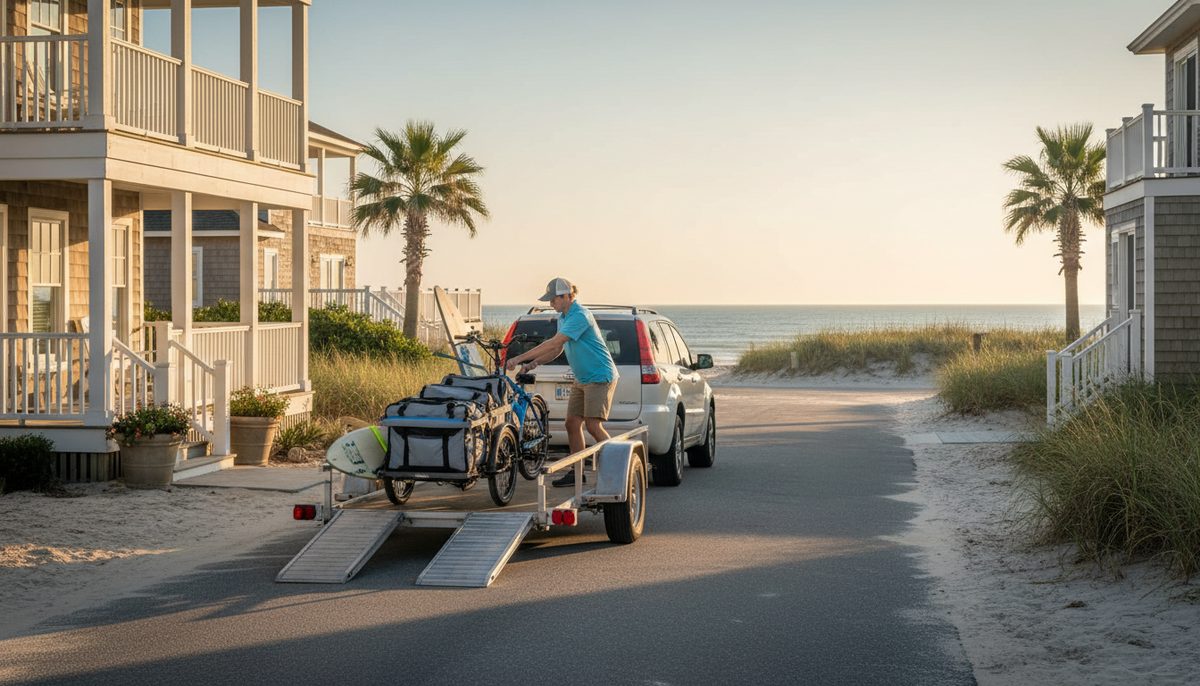
What it costs to get an e-bike to Ocracoke
The published fare for taking a bicycle on the Ocracoke Express, what the boat can actually carry, why the free vehicle ferry is not free, and when having a bike waiting on the island beats bringing one across.
The one fare on this coast with a published number
Most of the money in an Outer Banks vacation is quoted rather than posted. The Pamlico Sound crossing is the exception. The North Carolina Department of Transportation publishes the passenger ferry's fare directly: round-trip $15, bicycle $1, with children under three free. One dollar is what the state charges to put a bicycle on the deck of a boat and carry it twenty-odd miles across open water to an island with no bridge.
It is worth sitting with that number for a second, because it inverts how people usually plan this day. The crossing is not the expensive part of getting a bike to Ocracoke. It is very close to the cheapest thing you will do all week. What the crossing actually costs you is measured in seats, sailings and calendar, and that is what the rest of this page prices.
What the boat can carry, and why that is the real constraint
The Ocracoke Express is a passenger vessel, not a car ferry. NCDOT lists that it Ocracoke Express carries up to 129 passengers on a seventy-minute run between Hatteras village and Silver Lake Harbour, landing you in the middle of Ocracoke village rather than at a terminal several miles from it. That landing point is the whole argument for the boat: you step off with a bike and you are already where you wanted to be.
One hundred and twenty-nine seats is generous for people and finite for bicycles. Deck space for bikes is a fraction of the passenger count, and e-bikes take more of it than ordinary bikes because they are heavier, wider at the down tube and awkward to stack. On a fine Saturday in July, the binding constraint on this trip is not the dollar and it is not the seat — it is whether there is room on the rail for one more machine. Reserve the bike space the same day you reserve the seat, and treat a confirmed seat without a confirmed bike as an unfinished booking.
The free ferry is genuinely free and genuinely not cheap
There is a second way across, and its fare is zero. The Hatteras–Ocracoke vehicle ferry runs on its own schedule with dozens of scheduled departures each day, takes cars, takes bicycles, and charges nothing for any of it. On paper it beats fifteen dollars every time.
In season it does not. The vehicle ferry queues at the Hatteras terminal are the single most reliable time sink on this coast in July and August, and a missed sailing costs an hour of a day you cannot get back. It also lands vehicles at a terminal well outside Ocracoke village, which means the first part of the island you meet is a road, not a harbour. The honest way to price the two is that the passenger boat costs sixteen dollars and buys a scheduled, seated, village-to-village crossing; the vehicle ferry costs nothing and buys a queue whose length nobody can quote you. On a shoulder-season weekday the free boat is obviously right. On a peak Saturday it very often is not.
When a bike waiting on the island is the cheaper answer
There is a third option that removes the crossing question from the bicycle entirely: do not take one. Ride across as a foot passenger, and have the machine already standing at the other end. That is what a delivery service is for, and the arithmetic for it is simple — you are trading the dollar fare and the deck-space gamble for the certainty that a charged, sized, helmeted bike is where you are going to be.
The case gets stronger the larger the party. One bike on a boat is an errand. Four bikes on a peak-season sailing, with four people responsible for wheeling them on and off in a seventy-minute window, is a logistics problem with a real failure mode. It gets stronger again if the bikes are only wanted for part of the trip: a family spending three days on Hatteras Island and one on Ocracoke has no reason to carry hardware across the sound and back.
The bike does not change legal status when it lands
One thing that does not cost anything on either side of the water: a machine that meets G.S. 20-4.01(7a) — Electric Assisted Bicycle is a bicycle in Hatteras village and still a bicycle in Ocracoke village. Motor no larger than 750 watts, no more than 20 miles per hour on a level surface under motor alone, operable pedals. No registration is triggered by the crossing, no separate island permit exists, and the state's rules of the road arrive with you unchanged.
Practically, Ocracoke village is close to the best-case environment for a 20-mph machine anywhere on this coast: short distances, low speeds, a compact grid, and a harbour you can circle in an afternoon. The bike is doing easy work there. It is the getting-there that needs the planning.
Costing the whole day, rather than the fare
Put it together and a one-day Ocracoke ride from Hatteras looks like this: sixteen dollars per person and bike on the passenger boat each way, or nothing on the vehicle ferry plus an unquotable wait; a seventy-minute crossing each direction; a village that does not need a car; and a rental or delivery cost that depends on whether the machine crosses with you or meets you there.
The mistake we see most is a party pricing this trip on the fare alone, booking the free boat on the busiest Saturday of the summer, and losing three hours of the island to a queue. Fifteen dollars is not the number that decides this day. The sailing schedule is.
Tell us which crossing you are taking and how many bikes you want on the other side — we will either get them onto the boat with you or have them standing at Silver Lake when you land.
On the record: round-trip $15, bicycle $1 (N.C. Department of Transportation — Ocracoke Express Passenger Ferry (ncdot.gov, retrieved 2026-09-17)) · Ocracoke Express carries up to 129 passengers (N.C. Department of Transportation — Ocracoke Express Passenger Ferry (ncdot.gov, retrieved 2026-09-17)) · G.S. 20-4.01(7a) — Electric Assisted Bicycle (N.C. General Statutes § 20-4.01 — Definitions, subdivision (7a) (ncleg.gov, retrieved 2026-09-17))
Hand-verified 2026-09-17 against the primary sources named above; where a fact could not be verified it was left out, never guessed.