Outer Banks septic guide
Helmet rules for e-bikes in North Carolina
North Carolina's helmet answer depends on age today and will depend on the bike's class from December 1, 2026. Who is covered, who gets charged, what the fine actually is, and the helmet standard that catches fast machines.
Today the answer is decided entirely by age: under sixteen, yes, by law; sixteen and over, no legal requirement in this state. From December 1, 2026 a second test joins it, decided by the bike rather than the rider, and it catches a group nobody currently thinks about. Both tests are narrow, both are easy to satisfy, and the enforcement mechanics behind them are unusual enough to be worth understanding.
The details
The current rule is the Child Bicycle Safety Act. A Helmet required under age 16 (G.S. 20-171.9) on any public roadway, public bicycle path or other public right-of-way, whether they are operating the bike or riding on it as a passenger. Because a machine meeting G.S. 20-4.01(7a) — Electric Assisted Bicycle — 750 watts or less, 20 miles per hour or less under motor power alone, with operable pedals — is a bicycle for these purposes, there is no separate e-bike helmet statute to look up. The bicycle rule simply arrives already applying.
The enforcement design is the part that surprises people. The infraction runs against the parent or legal guardian, not the child. The fine is capped: helmet violation fine capped at $10, inclusive of all penalty assessments and court costs, and a first offence may be waived outright on proof that the parent bought a helmet or a restraining seat. And the statute goes further than most safety rules by stating that no civil liability imputed on account of a violation — which means the law will not be used against a family in a civil claim for having got this wrong. North Carolina is quite clearly trying to produce helmets rather than revenue.
The second test arrives with the statewide overhaul. From December 1, 2026, Class 3: helmet required under age 18 (from Dec 1, 2026) — any rider or passenger of a Class 3 electric assisted bicycle under eighteen must wear a helmet meeting federal safety standards, with a violation an infraction under G.S. 20-176. A Class 3 machine is the 28-mph pedal-assist category, and this is the first time North Carolina will key a helmet requirement to what the bike can do rather than only to how old the person on it is.
Between now and that date, a fast machine lands somewhere harsher. Because current law has no Class 3 category, a 28-mph pedal-assist bike is a moped, and the moped helmet rule is not the bicycle one: G.S. 20-140.4 — moped/motorcycle helmet, FMVSS 218. That is a DOT-certified motorcycle helmet with a retention strap properly secured, required of operator and passenger at every age, not a vented bicycle shell. Anybody riding a fast imported machine on North Carolina roads in a bicycle helmet right now is not in compliance and almost certainly does not know it.
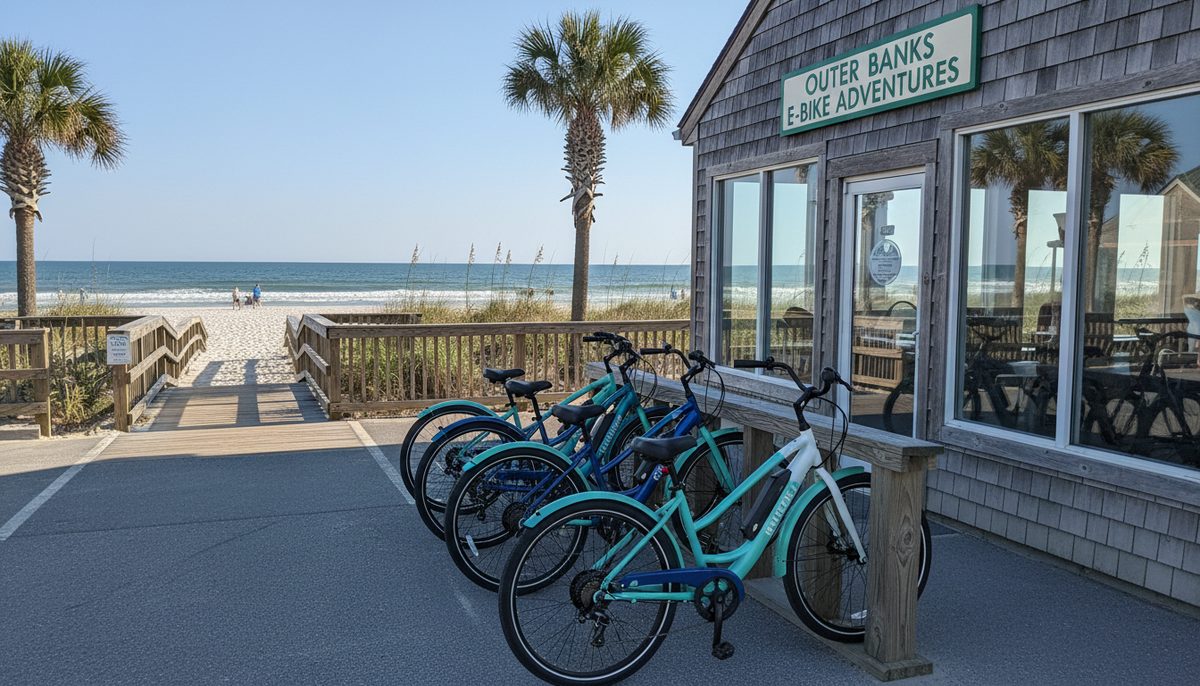
The practical advice is boring and correct: wear one. A rental fleet on this coast hands out helmets with every bike because the roads here are shared with holiday traffic, the wind pushes a light rider around, and sixteen miles of signed bikeway crosses a lot of driveways. The law only compels a minority of riders. The road does not care which side of sixteen you are on.
Under sixteen, it is the law and the fine lands on the adult. Sixteen and over, it is your call until December 2026, when the bike's class starts having an opinion too. We fit one to every rider either way.
On the record: Helmet required under age 16 (G.S. 20-171.9) (N.C. General Statutes § 20-171.9 — Requirements for helmet and restraining seat use (ncleg.gov, retrieved 2026-09-17)) · Class 3: helmet required under age 18 (from Dec 1, 2026) (UNC School of Government, Coates' Canons — New Statewide Legislation Regarding E-Bikes (retrieved 2026-09-17)) · G.S. 20-4.01(7a) — Electric Assisted Bicycle (N.C. General Statutes § 20-4.01 — Definitions, subdivision (7a) (ncleg.gov, retrieved 2026-09-17))
Hand-verified 2026-09-17 against the primary sources named above; where a fact could not be verified it was left out, never guessed.